

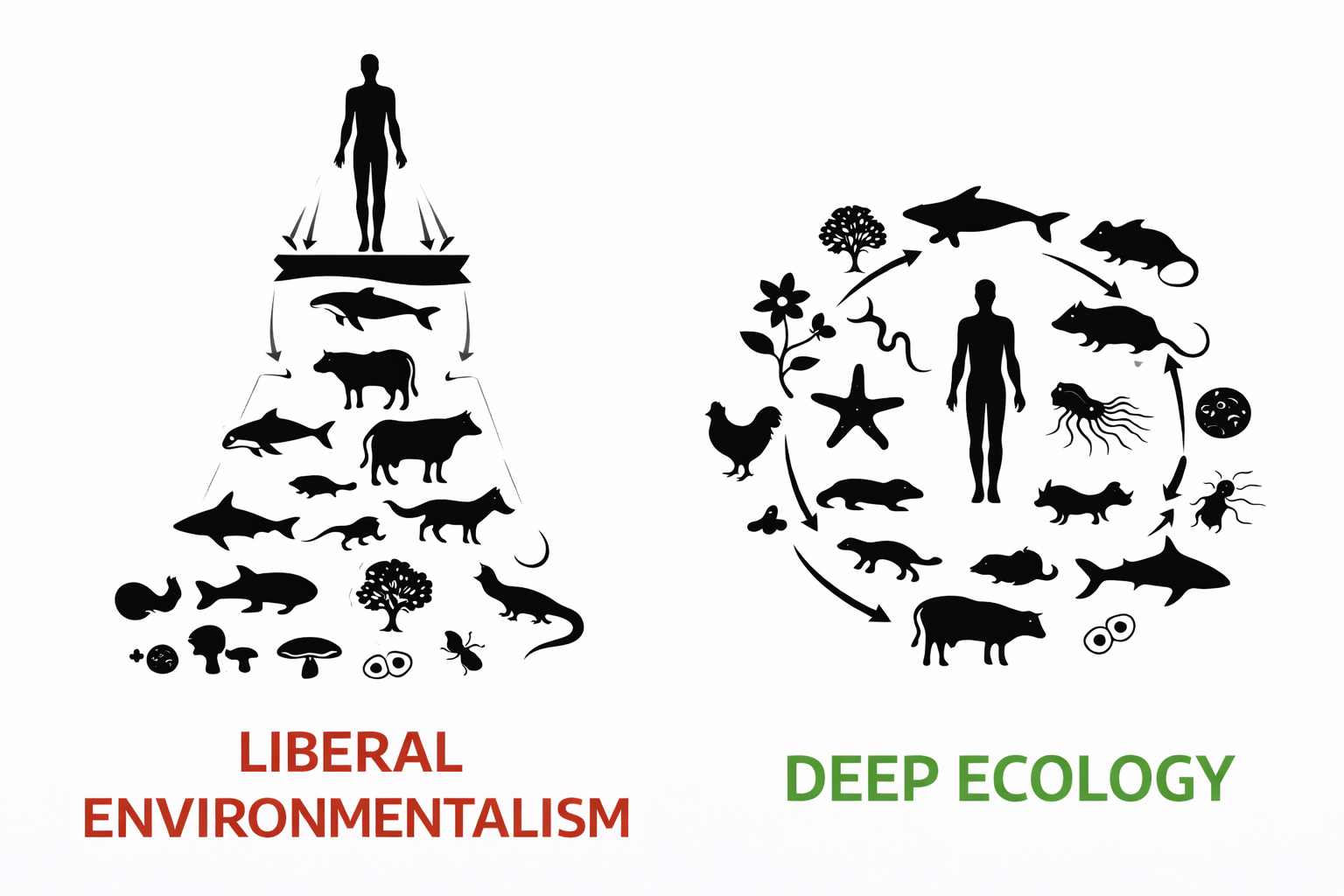
‘A shallow, but presently rather powerful movement, and a deep, but less influential movement, compete for our attention.‘ ~ Arne Naess, The shallow and the deep, long-range ecology movement: A summary, 1973.
Deep ecology calls for an emotional, moral, eco-philosophical and intellectual response to the ecological crises, in a political project of re-embedding humans as equals in the natural world. In a 1973 essay in the journal Inquiry, the Norwegian philosopher Arne Naess criticised the contemporaneous environmentalism as being human-centric, of saving nature to simply benefit human desires. He drew a distinction between two kinds of environmentalism: ‘Shallow ecology’ was concerned with protecting nature for human benefit: cleaner air, sustainable resources, a liveable planet. ‘Deep Ecology’ instead asked a deeper question: what if nature has intrinsic value regardless of what it offers us?
At the heart of Deep Ecology is a challenge to the former view, that the natural world derives its value from its usefulness to humans, best described as ‘anthropocentrism’. As a foundational support in modern environmentalism, Green politics rejects this anthropocentrism outright.
Within this framing, Deep Ecology also questions the damaging separation of humans from the land. Naess argued that nature has intrinsic worth independent of human interests, coining the term ‘ecosophy’ to set out a philosophy of ecological harmony. In Environmental Ethics, Holmes Rolston III insists that value is not something humans project onto nature, but something that we discover within it. And in 1986 Paul Taylor argued that every organism is ‘a teleological centre of life’ — it has its own ends and its own good — and that to ignore this is not just an ecological error but a moral one. The two ideas are, in fact, inseparable: it is precisely because nature has its own value — a value that exists independently of us — that our estrangement from it becomes not just a philosophical problem, but an ethical failure. This reflects deeper ideas within Green philosophy and politics about humility, holism and the hubris of human domination over and entitlement to the natural world.
Naess distilled these ideas into an eight-point platform for Deep Ecology. The first two principles are the most radical: all living beings have intrinsic value, and the richness and diversity of life are goods worth protecting in their own right — not merely as resources for human use. This places a strong emphasis on a sense of place and a oneness with nature, humans profoundly rooted in their local social and natural ecosystem, protecting wilderness, and the embrace of ‘eco-centrism’ over anthropocentrism. A Deep Ecology ideology doesn’t necessarily demand that we treat every insect as the moral equal of a person. It simply demands that we stop enslaving the entire non-human world into the service of human affairs.
Ecosocialist critique
Murray Bookchin, however, argued in Remaking Society that the real drivers of ecological destruction are social — capitalism, hierarchy, the state — and that urging people to simply think differently about nature, without addressing those structures, was a distraction.
Ecosocialism largely echoes Bookchin, that it is not how humans think about nature that drives deforestation, species loss, and climate breakdown, but the structural imperative of capital accumulation, the drive for endless growth, and the treatment of nature (and its destruction) as an externality or even benefit in the profit calculation (saving money by discharging sewage into waterways without legal consequence, for example). Changing consciousness without changing the mode of production, in this view, leaves the machinery of destruction intact.
Ecosocialism would also take issue with Deep Ecology’s tendency to speak of “humanity” as a unified agent — as though all humans bear equal responsibility for ecological harm. Indeed, the term ‘Anthropocene’ (the new post-Heliocene geological age we are moving into that is shaped not by natural events but by manmade impacts on the natural world) has been rejected by some for implicating all humans in the climate and biodiversity crises, and not distinguishing between the destructive impact of consumption-heavy lifestyles in the US and the far less resource-intensive lives of communities in, say, central Africa. Critics argue that the Anthropocene theory obscures class, colonialism, and power in its analysis. And the communities most responsible for ecological destruction are not the same as those who suffer its consequences most acutely. A philosophy that blames anthropocentrism in the abstract can end up, however unintentionally, letting the real culprit – capitalism – off the hook. In its place, the term ‘Capitalocene’ has emerged, shifting the implicated suspect from all humans on Earth to those industrial societies benefitting the most from destructive, extractive and polluting capitalism in the 250 years since the industrial revolution.
What’s more, ecosocialism would be suspicious of Deep Ecology’s call for personal transformation and philosophical reorientation. For ecosocialists, this is precisely the wrong emphasis. What is needed is not just enlightened individuals making ethical choices, but the collective political struggle of organised movements capable of confronting and dismantling the economic structures that make ecological destruction not just possible but, under capitalism, virtually inevitable.
Impact of Deep Ecology on contemporary Green politics

The influence of Deep Ecology on the Green political tradition is pervasive, even where it goes unacknowledged. Its most direct legacy is the foundational ethical shift: from nature as resource to nature as community. This biocentric premise underpins the Green emphasis on biodiversity protection, rewilding, and opposition to the wholesale destruction of ecosystems for economic gain — positions that go well beyond what a purely human-centred environmentalism would require.
Deep Ecology is also structured around asking urgent questions of social and political progress, emphasising heavily ecological concepts of biophysical limits, carrying capacity, tipping points and the importance of sustainable population levels. Aldo Leopold articulates these ecological ethics in terms of a ‘land ethic’ which understands social instability, violence and suffering as rooted in human violence against the land. The land ethic serves to enlarge the boundaries of the community to include not just other humans but the soil, water, plants and animals, all afforded equal respect: ‘In short, the land ethic changes the role of Homo sapiens from conqueror of the land-community to plain member and citizen of it’.
Nowhere are the calls for biospherical egalitarian found in Deep Ecology’s inheritance more visible than in the Green movement’s engagement with animal rights. The logical chain from Naess and others is direct: if non-human beings are centres of their own life with intrinsic value, then causing them unnecessary suffering — as industrial animal agriculture does on a vast scale — is a serious moral failing. As a result, Green manifestos across Europe have consistently supported plant-based diets and the reduction of factory farming. The framing, whether explicit or not, is deep ecological: animals matter because they matter, not because of what they provide for humans.
Deep Ecology, framing nature as intrinsically valuable, can be seen in other policy projects. For example, Green parties are supporting ‘Rights of Rivers’, a global movement that establishes rivers as living entities with legal personhood, granting them fundamental rights to flow, remain free from pollution, and regenerate. Similarly, there is a campaign to award the North Sea legal rights – it already has an Embassy, in the Netherlands. The premise, that granting the North Sea legal personhood and protection under the law, would enable the sea – with the aid of human proxies – to sue those who violate its rights in court. The Rights of Nature movement offers another striking example. Ecuador’s 2008 constitution granted Pachamama — Mother Earth — the legal right to exist and regenerate, independent of human utility. Similar provisions have since appeared in New Zealand, Bolivia, and Colombia. These are deep ecological principles translated directly into law.
Green politics moving on?
In many ways, Green politics has both evolved away from, yet retains a critical framework of, Deep Ecology. The most significant shift is towards ecological modernism: the belief that technology and reformed capitalism can solve the environmental crisis, without requiring a fundamental change in values, exists in more liberal forms of environmentalism. Solar panels, electric vehicles, and ‘green growth’ are the vocabulary of this tendency. It is a politics of transition rather than transformation, and it largely accepts the anthropocentric framework that Deep Ecology set out to challenge. This shift is arguably acknowledged within Green politics, but importantly is viewed as a stepping stone to the radical economic, social and cultural transformation actually required.
The social turn in contemporary Green politics — its emphasis on climate and economic justice, decolonisation, and the unequal distribution of environmental harm — reflects influences that go beyond the deep ecological tradition, and has also seen a rejection of the politics of population concern. Bookchin’s critique has, in a sense, partially won: certainly, UK Green politics now insist that ecological, economic and social justice are inseparable. Deep Ecology, with its primary focus on the human-nature relationship rather than inequalities among humans, has less to say here.
Deep Ecology gave the Green movement its moral spine. The insistence that nature has value in itself — not just for us — remains the most powerful challenge to the extractive logic driving ecological destruction. It lives on in Green commitments to animal rights, biodiversity law, and the growing legal recognition of nature’s own rights. But Green politics has seen a more recent turn to explicitly combining ecology with socialist economic policies (ecosocialism). This has had the effect of contemporary ecology moving definitively away from a focus on individual action, which critics argue loads the blame for climate change onto the lay person, and responsibility for combating it on individual behavioural change, to collective action rooted in class solidarity. This analysis implicates the true culprits of the climate and biodiversity crises: extractive capitalism, the corporations and billionaires that gain from it, and the governments that refuse to safeguard our world against their rapaciousness.
Deep Ecology doesn’t supply easy answers. But it asks a lot of the right questions.

