


‘We are committed to dissolving state power, authority and sovereignty into an inviolate form of personal empowerment.’ ~ Murray Bookchin, The Ecology of Freedom: The Emergence and Dissolution of the Heirarchy.
Anarchism, at its core, rejects all forms of coercive hierarchy and advocates for voluntary cooperation through mutual aid, direct democracy, and decentralised self-organisation. Anarchists oppose not just capitalism but the state itself, arguing that concentrated power inevitably corrupts and oppresses regardless of who wields it. Because anarchism broadly views the state as an instrument of repression, a vehicle of class war for controlling working classes through police force, a coercive machine for extracting wealth and resources, all the while dispossessing communities through upwards redistribution of the means to sustain themselves autonomously.
In its place, family and community replaces state functions of welfare, security and protection, governed by self-regulating village or community assemblies or ‘village republics’.
Green anarchism
Green anarchism, or eco-anarchism, extends this anti-hierarchical analysis to the environmental crisis. As wildfires rage, sea levels rise, floods intensify and climate shocks destabilise vulnerable states, mainstream environmentalism offers familiar, in adequate prescriptions: carbon taxes, international treaties, corporate sustainability pledges. Green anarchists reject this entire framework. For them, ecological catastrophe and political domination share the same root, and no hierarchical system—whether capitalist or state socialist—can solve a crisis it fundamentally created.
Anarchists see themselves as representatives of the true evolution of human society, and extend this rejection of domination to include the non-human world. US ecologist Murray Bookchin, a leading thinker in social ecology and eco-anarchism, argued that ‘the idea of dominating nature has its primary source in the domination of human by human.’ Writing in The Ecology of Freedom, Bookchin traced environmental destruction to the emergence of hierarchy itself—long before capitalism, in the earliest forms of patriarchy, gerontocracy, and stratified communities.
This represents green anarchism’s foundational insight: you cannot heal the planet without first dismantling systems of control, coercion and domination over people. Reforming these systems, even into a socialist state, Bookchin insisted, merely perpetuates the problem.
This perspective has deep roots. In 1902, Peter Kropotkin published Mutual Aid, challenging the prevailing narrative, assigned to a Darwinist discourse of ‘survival of the fittest’, that nature operates through ruthless competition. However, Kropotkin challenged this narrative by documenting extensive cooperation among species, from pelicans fishing collectively to ants maintaining complex symbiotic relationships. He wrote that, ‘Sociability is as much a law of nature as mutual struggle.’ Thus, Kropotkin provided an ecological foundation for anarchist politics. If nature thrives through cooperation rather than domination, Kropotkin suggested, then human society organised into complex and often brutal hierarchical structures violate our own ecological nature.
Governance and bioregions
The practical implications are radical. Anarchists reject party politics and attempt to achieve change through the state, regardless of who holds the levers of power. In a warning for all Green parties seeking executive office, former leader of the German Greens Rudolf Bahro even went so far as to say that his former political party became ‘a counter-productive tool’ that identified itself with ‘the industrial system and its political administration.’
Indeed, one of the central critiques from anarchism is the concentration of power in too few hands, a concentration that can lead to corruption, unilateral rather than democratic governance, and/or an ever-increasing space between the governing and the governed. Green anarchists advocate instead not just for decentralised communities organised through direct democracy, but organised into ‘bioregions’ – a region defined by characteristics of the natural environment rather than by man-made divisions.
Kirkpatrick Sale, in Dwellers in the Land, articulated the bioregional vision: societies should organise around watersheds, ecosystems, and natural boundaries rather than arbitrary nation-states. Reflecting anarchism’s belief in localised self-rule, Sale argued that, ‘The limits of its resources; the carrying capacities of its lands and waters; the places where it must not be stressed; the places where its bounties can best be developed; the treasures it holds and the treasures it withholds–these are the things that must be understood. And the cultures of the people, of the populations native to the land and of those who have grown up with it, the human social and economic arrangements shaped by and adapted to the geomorphic ones, in both urban and rural settings—these are the things that must be appreciated.’
This requires dismantling not just corporations but the centralised state apparatus itself, replaced by confederations of self-governing communities scaled to their ecological contexts. This is one of the broadest disagreements with ecosocialism – if the goal is to create an ecological society of inter-dependent but autonomous bioregions and communities, the means cannot involve the strengthening of the state.
Bahro argued that this type of social organisation, communities managing themselves according to their needs and necessity to conserve and protect their local biosphere, would displace the all-encompassing drive for economic efficiency in favour of ecological imperatives of reducing resources use and building social cohesion. The South African academic and activist Vishwas Satgar goes further still to suggest that the ‘feminine element’, touched on in a recent Green Isles post on ecofeminism, would impact the regulation of community affairs as social bonds are strengthened through cooperation, face-to-face interactions and the emergency of what he called a ‘solidarity economy’
Strategy – how do we get there?
But how to achieve this remains relatively unclear, for now. For anarchists, these goals are best achieved from below through popular struggles. Direct actions and the building of direct democracy, constructing mutual aid and local self-help initiatives all contribute to building the political and economic autonomy of local communities.
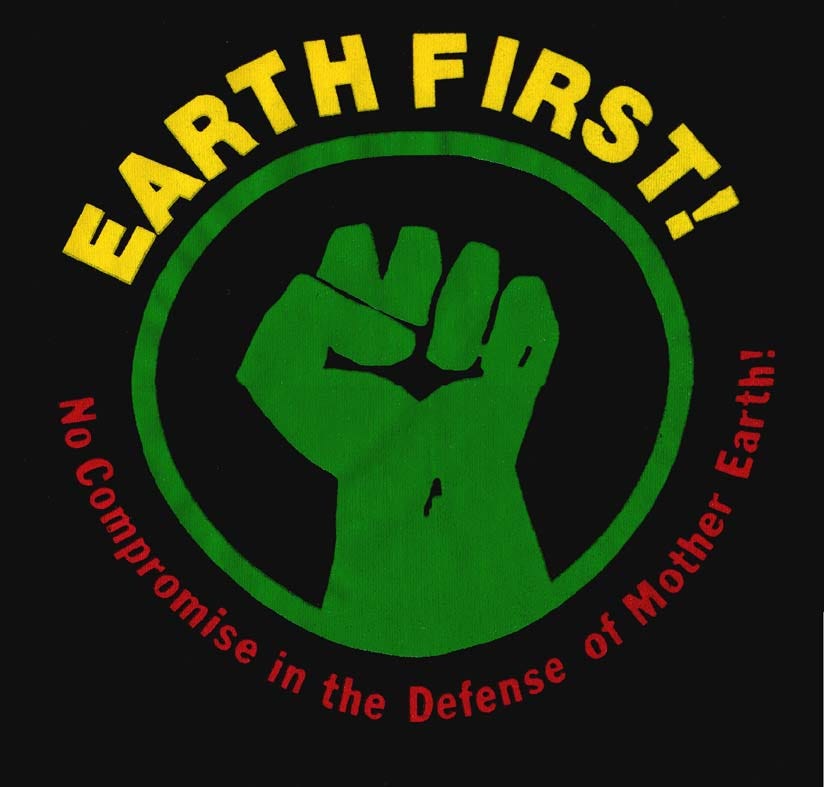
Direct action forms the eco-axctivist movement’s tactical strategy. Quoting American writer and environmentalist Edward Abbey, Dave Foreman, co-founder of Earth First!, declared that ‘sentiment without action is the ruin of the soul,’ justifying tree-sits, equipment sabotage, and physical blockades against ecological destruction.
For these activists, waiting for legislative change while forests fall and species vanish represents moral complicity. As climate emergency intensifies, eco-anarchists claim to offer a coherent critique: the same institutions destroying the planet cannot be trusted to save it.
Whether through autonomous zones, bioregional confederation, or indigenous land defence, the movement insists that ecological survival requires dismantling hierarchy at its roots. As Bookchin wrote, ‘As long as hierarchy persists, as long as domination organises humanity around a system of elites, the project of dominating nature will continue to exist and inevitably lead our planet to ecological extinction.’
Eco-anarchism and the current Green thought?



Many of the ideas at the heart of eco-anarchist thought continue to shape the contemporary Green movement to varying degrees.
Like anarchism, the Green Party of England and Wales (GPEW) particularly has at times struggled with the suspicion of a concentration of executive power; until 2007, the Party was governed by a rotating cast of internally elected officers, two of which were elected formally as the male and female ‘principal speaker’ to be the public-facing representatives of the collective. An internal referendum saw the GPEW change to the more conventional leadership roles of today.
But the UK’s Greens’ commitment to both national and regional devolution remain rooted in this anarchist tradition. The movement itself is devolved into national represerntation rather than a single UK-wide political party (the only party to be structured thus); Scotland and Northern Ireland Green parties have long been separate, independent entities, while the English Green Party is joined with Wales until the Wales Green Party members decide otherwise. But more than a national devolution that would force a reshaping of UK governance, anarchism is reflected in its policy commitment to the devolution of all political and economic power and decision-making from the UK Parliament to Regional Assemblies, or even to county-wide councils should voters choose it. Devolved executive powers would give people a stake in the decisions that directly impact them, the ability to shape their communities around local needs, and would ensure, to quote one of the GPEW’s core values ‘that decisions are taken at the closest practical level to those affected by them.’ While not quite bioregions, this programme of devolution would begin to look like the autonomous communities prevalent in the anarchist tradition.
Direct action of course remains a strategic and considered approach by Greens to address injustice when democratic systems fail to produce timely or just outcomes. But possibly unlike some anarchist strategies, direct action within the Green movement remains avowedly nonviolent, a commitment established as one of the six guiding principles of the Global Greens Charter (the other five being ecological wisdom, social justice, participatory democracy, sustainability and respect for diversity).
Meanwhile, the anarchist rejections of domination over others that is extended to include non-human life may even lie at the heart of the Greens’ strong historic commitment to the rights of animals, its promotion of vegetarian and vegan diets, and in policies such as giving rivers legal rights as living entities, with rights to flow, be free from pollution and support biodiversity, and not be reduced to resources from which to extract economic value.
But one aspect of anarchist thought that the Green movement has decisively disregarded is in its attempt to capture the state and state bureaucracy by contesting elections at every level of governance. This is likely influenced by the shared belief that there simply isn’t the time or luxury to wait for the social transformation into self-governed autonomous bioregions. As Australian professor and eco-anarchist Robin Eckersely says, ‘Many threatened species, habitats and tribal communities are unlikely to survive to see whether mutual aid and ecological restoration will indeed ensue from the eco-anarchists’ strategy of… seeking to dismantle hierarchical structures such as the nation state.’

