

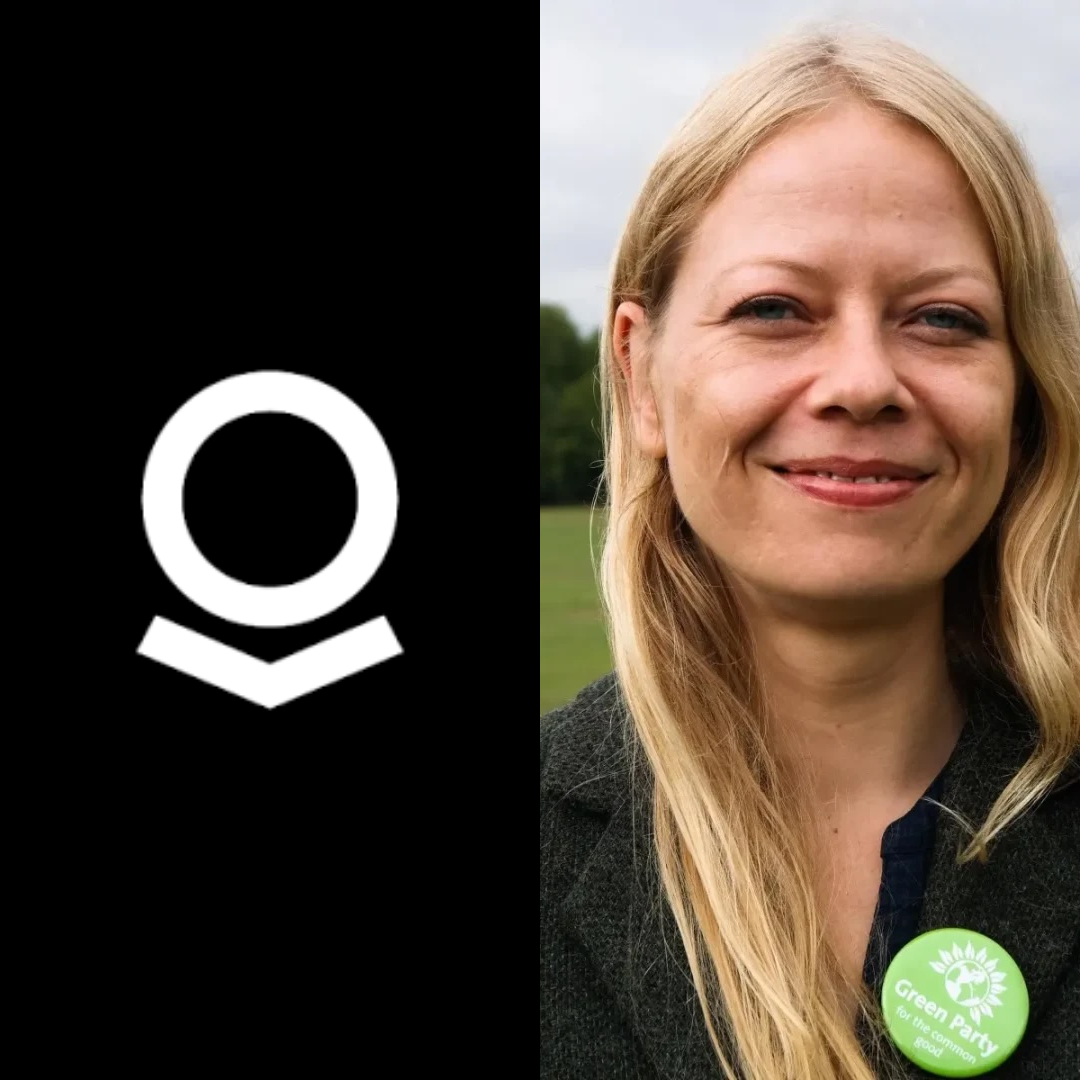
Green Isles editor Matt Hanley speaks to Green MP Siân Berry.
“Palantir has openly stated their intention to exploit and subjugate the British public for profit and power…“
Palantir Technologies started out as a CIA-funded data intelligence company. Today it holds contracts worth over £670 million across at least ten UK government departments, including NHS England. Its own executives describe the strategy openly: “land and expand” — get in cheaply, create dependency, then extract. Green MPs wrote an open letter urgently calling for an immediate inquiry into the Government’s current contracts with US-based spy-tech giant and the influence that Peter Mandelson had on these contracts.
Siân Berry, Green MP for Brighton Pavilion, has been one of the few parliamentarians systematically challenging that expansion. She talks to Green Isles about free trials, pre-crime databases, million pound contracts that never went to tender, and what it would actually mean to take back control of our public data.
Palantir has managed to embed itself in the NHS, the Ministry of Defence, the police, and at least seven other government departments. They didn’t win most of these contracts in open competition — in several cases they got in via free trials, pilots, or crisis contracts. What’s actually going on with their strategy?
There are tentacles here that stretch into so many corners of the British state. The amount of different interventions I’ve made on Mandelson and specifically on Palantir, and all the stuff that’s going on around that particular company! But also on the wider issues, I’ve done a lot of work with Open Rights Group (ORG) on digital sovereignty and open source, and I have even heard from people within DSIT (Department for Science, Innovation and Technology who are worried too.
“It’s how to create an unnatural dependency on something, which is essential when you have much more to gain from a long-term association than just simply winning the contract.“
I think the way Palantir keep dodging procurement rules is very suspicious because they are ‘loss-leading’. They are giving out free provisions for people to use and then creating dependency from that, which is what drug dealers do! Creating an unnatural dependency on something is essential when you have much more to gain from a long-term association than just simply winning the contract. That’s why they offer so much for free, and why they can beat other quotes and bids. But that doesn’t mean we shouldn’t be paying attention to the risks. Hence, the digital sovereignty strategy push, and making sure that existing precautions that there are in procurement policies are actually followed, and that people don’t just have AI glitter in front of their eyes. We need to change the conversation from ‘We must dive into AI ASAP, and therefore we cannot possibly wait to develop our own stuff. We have to buy it right now!’
The London case is really interesting — Sadiq Khan managed to recently block a Palantir contract with the Met. How did that actually happen, and what does it tell us about where the leverage is?
I recently had a chat with Theo Blackwell, who’s the Chief Digital Officer for London, and I hope this reminder of the risks, and the excellent policy that London has had for ethical tech for a while now, helped prompt the Mayor to do what he did to block that contract. They have a good digital strategy at City Hall that supports digital autonomy, supports building their own open source systems, and being really transparent with people about what data is being collected about them. It does need an update on digital sovereignty specifically, and I hope that will follow too.
The key issue is Palantir’s predatory approach. They are aware that accessing government data and infiltrating public services serves their interests and have been so forthright and open about it. The Met contract in London is a good example. They offered the Met a free trial, and because it was free it enabled Palantir to circumvent standard procurement rules. But this also allowed Sadiq Khan, once he got wind of this, to see this procurement was improperly conducted Aand did not comply with the rules. And, as I said, it fundamentally contradicts the principles of London’s data policy.
There’s a tendency to think of this as a dry procurement story — contracts, tenders, government IT. But what Palantir actually does is aggregate data to build detailed profiles of individuals. Their company has been explicit about that. When we’re talking about NHS data — people’s medical records, their whole health history — what’s the real nature of what’s being handed over?
I think those were the same suspicions about this Government’s digital ID project, because people do not believe that there won’t be mission creep, that you won’t be catalogued under one number in a central government system, with so much of your person information pushed into one place. The centralisation of data under a single identifier raises the risk of a significant amount of personal information being consolidated, which is really dangerous and has the massive potential to compromise people’s privacy. This is one of the fundamental principles of data protection: it should not be allowed for different types of data to be easily matched to build up a wider picture of someone, to create a comprehensive profile of an individual. That is in itself a greater invasion of your privacy than keeping bits of your data safely apart from each other.
“The centralisation of data under a single identifier raises the risk of a significant amount of personal information being consolidated, which is really dangerous.“
But this is the exact opposite of Palantir’s manifesto, which openly advocates for the collection of all data in order to spy on people, in order to build up intelligence on individuals. The company’s activities supporting ICE in the US and the IDF in the genocide in Palestine are really sinister and concerning, and people are getting wind of it. So I really want there to be a big conversation, not only about data digital sovereignty, but also about national security. With cross-party MPs, I have already written about the national risks it poses to the chairs of the Science and Technology Committee and the Joint Intelligence Committee, and the Minister responsible, who oversees this area in the Cabinet Office.
You helped expose and dismantle the Met’s Gangs Violence Matrix when you were on the London Assembly. That was a predictive, data-driven system that turned out to be deeply racist in practice. Now we’re being asked to trust AI-driven systems built on the similar institutional data. Why should anyone be confident this time will be different?
When developing smart city technology is discussed, the conversation is usually around how we will do this or that in a particular way. But it is also about things like the Met police putting together a ‘pre-crime database’. The Gangs Violence Matrix was a map of London that added little flags to people’s records, including people who didn’t have criminal records but had been stopped the searched at some point, flagging up a checklist of possible risk factors that increased the chances of them were in a gang. You can imagine how well that turned out! It really was discovered to be the most racist thing you could possibly imagine, because basically they were hardly adding any white kids to this database. The main risk factor in the police’s heads as far as many of us could see was the question, ‘Are they Black?’ I was on the London Assembly then and, along with Jennette Arnold and Florence Eshalomi, brilliant Labour colleagues working on this on the Assembly, we managed to get this exposed, and the thing was essentially dismantled.
“I think that Greens do have a really big libertarian streak… central to the Green philosophical basis is community-led and community-level control over our lives, and that is the philosophy of the open-source and open data movement.”
AI is biased in a very similar way, right? Because Black people are overly criminalised from school onwards, that ends up being a significant thing to the way the AI systems collect data. Using existing data it can erroneously and horrifically start to assume that Black people are somehow criminal, and so it starts being racist itself. It’s really obvious that that’s going to happen. And I just cannot imagine that anything that the Met puts together based on their own data, which is already informed by the incredibly large amount of systemic racism there is in policing, is not going to become even more racist.
It’s easy to assume that the only alternative to buying systems from the likes of Palantir is just having no systems at all. But there’s actually quite a lot of publicly-owned, open-source digital infrastructure that already exists or is being built. What does that look like, and what’s at risk of being bypassed?
Yes, how we can build something that truly respects principles like privacy, like openness and open source, things that these private companies are allergic to?
These principles are actually already part of a set of principles the Government has signed up to. When websites were fairly new, back in the day, organisations like MySociety with websites such as TheyWorkForYou were good at creating open-source and transparent feeds of what elected people were up to, tracking MPs votes, and allowing us to write to our MPs and elected reps too. These are openly accessible digital tools created for the public good, not private monetisable things. We can return to these principles, which are already in broad government policy.
There is something called the Government Digital Service, which is tasked with developing our ‘digital backbone’ and transform the provision of online public services. And then you’ve got a bit of an offshoot of that called Government Digital Service Local that strengthens collaboration between central and local government on digital services. This means that, encouragingly, we have parts of government that are writing their own in-house programs – they have a digital problem to solve, and doing things like trying to get all their planning data online, or they might need a new digital system for their parking. So these councils and departments are sharing code and building their own software, and that could really be scaled up properly with a bit more leadership within the Government Digital Service.
But then companies like Palantir are trying to short-circuit all of that by coercing government agencies to sign a load of massive contracts with them, but it would be so much better for each local council and each government department to be building their own stuff, and building it interoperably, maintaining the ability to export the data to a new system if they needed to. You can’t do those things with a massive private system.
But there is a significant push from sales people, like Palantir, to privatise all this data so it can be monetised and exploited. They are able to connect with ministers and civil servants and bamboozle them with new buzzwords about digital infrastructures and AI. But what they’re doing fundamentally breaks these principles of openness and transparency that I think the public are very signed up to.
We need to have this conversation and highlight these scandalous examples, like the Met contract, like the NHS contract, and the disgraceful actions of Palantir and what they’re saying and doing elsewhere. The Palantir execs have openly stated their intention to exploit and subjugate the public for profit and power, so that powerful individuals can control our lives. Nobody wants that, particularly not British people. So I think we can really get the public interested in this if we push and push.
There’s actually a piece of US legislation — the Clarifying Lawful Overseas Use of Data (CLOUD) Act — that most people in this country have never heard of. But it has enormous implications for any public service that runs on American technology. What does it actually allow?
The CLOUD Act permits US government authorities to compel US-based tech companies to hand over data it controls, regardless of UK jurisdiction or physical location. Or it allows a President to, say, potentially invoke emergency legislation or sanctions to literally force a US company to turn off our public services. So that means that the US government is free to look at and use our data, and could also in certain circumstances tell those companies to turn off parts of the NHS. Stealing our data is one thing, but the ability of a foreign state to be able to switch off the NHS is surely a worry! That’s one of many reasons why our digital sovereignty is so important.
You’ve been pushing for digital sovereignty to be formally included in the national security risk register. Why does that framing matter — why isn’t this just a tech policy question?
I’ve been making the point in Parliament around digital sovereignty being a national security issue, and needing to be included in the national risk register (NRR). That’s why with Ben Lake MP (Plaid), Victoria Collins MP (LibDem) and Clive Lewis MP (Labour), I have written the joint letter making this argument. If digital sovereignty risks were properly on the NRR it would mean Parliamentary scrutiny committees like the audit committee and the science committee can properly scrutinise what’s going on and frame the issue in a strategic way.
We did get a very interested response to this letter to the Government from Matt Western MP, the chair of the Chair of the Joint Committee on National Security Strategy (JCNSS), the committee that has oversight of the risk register and is, like us, looking forward to the minister’s response and what comes of it. Greens never received a response to our joint letter specifically about Palentir, Mandelson and Epstein, but I am more hopeful this will be taken up.
I do think we’ll have some success in our campaign for digital sovereignty on this score, because there’s no denying that dependence on private companies for our digital infrastructure is a risk.
Let’s talk about how Palantir actually got its biggest UK contracts. There’s a meeting at the British Embassy in Washington between Keir Starmer, Peter Mandelson — serving as UK Ambassador, but also a stakeholder in a lobbying firm with Palantir as a client — and Palantir’s chief executive. The meeting wasn’t on any official schedule. Shortly afterwards, Palantir wins a £241 million MoD contract, untendered. How corrupt is this?
People’s rights in all of this is deeply connected to the quite blatant corruption of the Mandelson affair; the fact that the meeting between Starmer, Mandelson and the Chief Exec of Palantir in the USA, where photographs were taken, wasn’t official, wasn’t part of a published itinerary of the Prime Minister, and was set up by Mandelson in his role as the ambassador. While he was US Ambassador, Mandelson also had a side venture with Palantir as a major client, and this meeting happened, and then they happen to win a major £241m contract with the MOD without any competition.
“Your powers of deduction don’t have to be that strong to realise this is just government corruption on an extraordinary scale.”
Your powers of deduction don’t have to be that strong to realise this is just government corruption on an extraordinary scale. The fact that it was kept secret makes it even worse. Did the Prime Minister just not know who he was meeting that day? Who knows for sure, but it’s unlikely. And we know there’s a lot more to uncover, and the links to Epstein are clear, at the Mandelson and Palantir levels. Hopefully the police will keep looking into more of the unredacted Epstein files.
Tony Blair’s Institute is heavily funded by Larry Ellison of Oracle, another US tech company investing heavily in AI. Blair’s daughter-in-law has just been handed control of the Government’s £500 million Sovereign AI Fund. The word “sovereign” is doing a lot of work there. How do you read it?
Practically, until we have our own physical servers that are big enough to carry our own large language models (LLMs), we are going to be dependent on at least borrowing versions of these proprietary LLMs. We won’t have our own sovereign LLM until we’ve built the infrastructure, so there is work to do, and money does need to be spent. But, you know, the Government’s new AI fund is called ‘sovereign’, so that may be a start. However, it is a bit weird that it’s someone who is essentially related to Tony Blair who has been put in charge of this!
The “No Palantir in the NHS“ campaign has been strongly rooted in Palestine solidarity — Palantir holds a contract with the Israeli military for “war-related missions.” That’s a powerful moral argument, but it may not be the argument that shifts the most people. How do you build a coalition broad enough to actually win?
There is a policy hook there around ethics. It is not legitimate to award a contract to a company that is participating in war crimes, even under current law. There is Government procurement guidance that makes human rights considerations something important to consider. People care about this aspect of it, so framing this as an ethical and moral question is not only important but also a decent campaign tactic.
But I also think people are more worried about their own privacy and their own security than wider ethics and world events on this issue. People just do not like authoritarianism in this country. I like to quote Winston Churchill when he abolished wartime ID cards in the 1950s, when he said essentially: “Set the people free”. These issues of personal freedom from state intrusion stretch right back to the Levellers and the Chartists, all of these traditions that we have in British history of standing up for the individual’s right to choose who rules us.
And then, given the level of control and dependency of our lives on digital tools, giving over that level of control, of who runs our public services, to a company that we don’t trust is so against all of those principles that I think there’s these wider British values we can appeal to. If we do include building the digital sovereignty strategy in the national risk register, then there’s an appeal to national pride and resilience as well.
We’ve been here before in some ways. When Lockheed Martin — a weapons manufacturer — won the contract to run the 2011 census, there was a public campaign, and they didn’t get the next contract. Is that a useful precedent?
Lockheed Martin, which is literally a weapons of mass destruction company, for some reason thought it might like to run our census, and won the contract to carry out census processing. After Greens and others kicked off massively about this, we got reassurances from the Government that they had specified in the contract that the service needed to be confined to the UK, and all the data must remain in the UK. And then they didn’t get the next contract, did they? They were kicked off running our census pretty quick. There are always huge reasons not to put companies that supply arms and military equipment to other governments in charge of massive amounts of our personal data.
Switzerland rejected Palantir on national security grounds. France and others have taken similar action. The EU has pretty robust AI legislation now. The UK seems to have gone the opposite direction. Why do you think this might be?
Because of Brexit, we don’t have to comply with as many EU laws anymore and we are falling behind. I mean, we’ve been exceptionally bad, for example, at regulating facial recognition tech, which is not just being used by the police, it’s also being used by private companies. That’s a form of AI that is really dangerous and invasive to people’s privacy, and more. The EU went through the process of putting in place AI legislation (the EU Artificial Intelligence Act), which protects people’s rights. But the UK Government instead sat on it, and let facial recognition here become a complete wild west. Ministers have only now started consulting on our own legislation on that, and the Biometrics and Surveillance Camera Commissioner has just written a cracking letter in response to the government consultation on it, so watch this space.
Because of Brexit and the fact we are making our own AI laws, I think we have been a particular target for the tech companies that want to expand. They’ve lobbied the hell out of it. Of course they have. Of course they have made sure that their powerpoint presentations have reached the eyes of as many ministers as possible. They’ve courted and invited ministers to lots of swish events. And the problem is, we don’t have enough ministers who properly understand – with an eye for risks and evidence – science and tech. For example, you have got people like Peter Kyle, who was in the Department for Science, Innovation & Technology (DSIT) and is now Secretary of State for Business and Trade, and he loves all this stuff, but I genuinely don’t think he understands the implications of it or asks any of the right questions. I think he’s been a bit blinded by the science and the salesmanship.
I think that most MPs too have not thought about it hard enough, or asked enough questions. And they are being sold these concepts and products by good sales people without having the curiosity to really ask the questions around privacy and rights and resilience and the worst case scenarios that are what the business model of a lot of these companies are based on. It’s just very, very poor leadership all round, and it’s poor leadership in not developing the alternatives here either. There are many examples of other countries doing much more to build up infrastructure and software as alternatives that are actually homegrown and government-owned, while also being open-source and non-profit making. These are all good things that should rather be doing.
You’ve got 48 MPs signed up to your Early Day Motion (EDM) on digital sovereignty, cross-party co-signatories on the National Risk Register letter. But 650 MPs sit in Parliament, and the government has a massive majority. Is parliamentary scrutiny actually working here?
The Tories and Labour are not significantly different when it comes to their relationships with outsourcing and big business. I think that the progress that we made with London was to do with the fact that there was good scrutiny in the Assembly, that we were able to ask a lot of questions, that when new systems were being procured there were enough people doing scrutiny to spot contracts and ask questions about them. It was manageable.
And of course these big tech companies also have in their sights the aim to undermine the ability of free and independent media to do this kind of work. So, I think MPs are trying to doing the same job they always did, and we clearly need a better system of scrutiny. But I think the real danger is the undermining of the ability to hold people to account in the media and by journalists.
Whereas there are 650 MPs in Parliament, with a massive majority for the government, and more than half of the MPs are fatally uncurious about what’s going on. You’ve got all these Labour backbenchers who are not in any way motivated to ask questions about this, apart from a handful of people on the science committee. Then you’ve got the Opposition, who are mostly Conservatives because of first past the post and the two-party system, so the burden on people like me, people like Victoria Collins from the Lib Dems who tries to lead on this, and on people like Ben Lake from Plaid, is very high, because there’s far too much to scrutinise for just us few.
I push more generally on openness and transparency, publishing my meeting logs and arguing for more rules on being transparent about who you’re talking to, for example. We need more of that kind of data to be out there in public, partly for the paid scrutineers like me, the people who’ve got the democratic right to scrutinise, but also so that journalists can look at all of this, too. The Freedom of Information (FOI) Act is really useful for journalists to access information that Ministers might not like to be made public, but it is being completely undermined and disregarded by too many public authorities. Too many things are being obstructed from being released – I speak to so many journalists who tell me this. But getting more stuff out into the public domain so that the media can see it, so that there’s light shone on it. That would back up the important role I think that journalists have to play.
Part of the problem is that when MPs hear “AI” and “data infrastructure” they think it’s a technical issue — something for the science committee, not something that has anything to do with them. But these decisions are really about much deeper moral and philosophical questions on who controls our public services and, in a real sense, who has power over our lives. Do you think that political dimension is getting through?
I think you’re right, people think it’s some separate tech thing, but it’s so embedded in our lives now, and it’s so important, and has carried so many risks that that we do need everyone to be paying attention. We’re literally talking about the foundation of everything that we use and rely on in almost every minute of our lives.
We all had these kinds of thoughts when we first got iPhones and things like that, but now even where people are aware of what they’re sharing through their phone they can be quite blasé about it all. But I think when it comes to our public services, they remain very concerned that the public services themselves are run by alternatives that are ethical, that are open source, that are safe, and not part of gigantic tech companies.
On the other hand, I worry that too many people think it’s normal for everything to be run by big tech companies, and we really need to change that casual view. We need to do more to make it feel abnormal to be so dependent on companies that are not working in our interests, but in their own.
What is it about Green politics specifically that makes these questions — about who owns data, who controls public infrastructure, openness, accountability — feel so central rather than peripheral?
I think that Greens do have a really big libertarian streak, so these issues will always raise flags with the Greens. But central to the Green philosophical basis is community-led and community-level control of things, control over our lives, and that is the philosophy of the open-source and open data movement.
We also believe really strongly in the parts of Nolan principles of public life that are about accountability and openness and transparency. Those principles intersect massively with Green values, and I think that’s partly why we’ve been so consistent about it for many years: for example, the Greens in the EU were a driving force behind a lot of the data security and AI legislation within the EU, legislation that we’ve abandoned through Brexit. So campaigning on these issues are really strongly aligned with a lot of Green philosophy and principles, and I think always will be.
When I was a London Assembly member I was bringing data security up at every opportunity, even when we were talking about something like road charging and other policies I support that needed privacy including from day one; the idea that people will reject systems that they believe are spying on them is really powerful, and I think that’s why the public is very aggrieved by the NHS contract, particularly when they know what Palantir’s ulterior motives are.
The NHS contract comes up for renewal in February 2027. The BMA is telling doctors to limit their engagement with the Federated Data Platform. NHS Greater Manchester has refused to use it. What does the realistic path to cancellation — or at least meaningful reform — look like?
There will be cancellation fees if you cancel contracts already signed or underway. But I think these contracts and companies really do need to be properly, publicly scrutinised, and new decisions made based on that scrutiny whenever needed. For example, it is possible that some of our data has gone astray already, which would be grounds to cancel any contract.
Obviously, the NHS needs to function, but I think the BMA and others who are calling on their members and institutions within the NHS not to move into this system are right; we should urgently be putting together an alternative plan, and in the meantime not be making the risks even worse.
You’ve been writing about open-source and digital governance since the mid-2000s. Is the fight now fundamentally different from what it was then, or are you still pushing at the same basic problem?
This is just very important. Through my history of working, first of all on the census, doing lots of promotion of open-source, and writing about it in a New Statesman column in the mid-00s, I have always recognised the importance of these issues. Things go in the right direction, or they go in the wrong direction, and you have to make an intervention. So, I’ll always do that when needed. ORG know that I’ll always be there to be called upon when something needs saying or reporting in Parliament. And we do need more MPs like me, who get how fundamental this all is to our daily lives and human rights, and won’t just leave it in a box marked ‘tech’.

